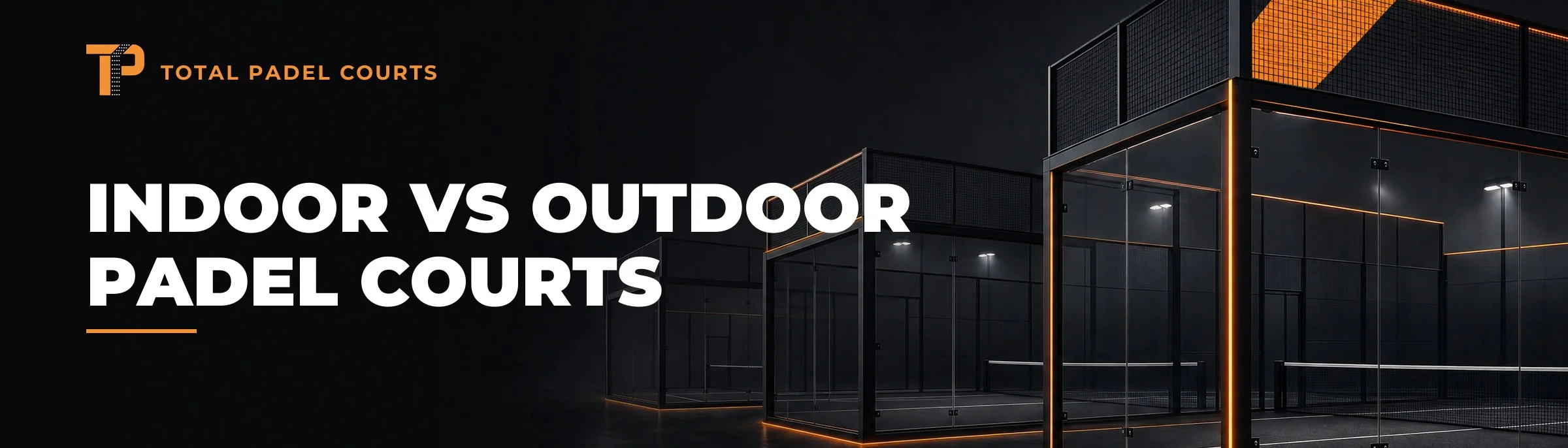
Indoor vs Outdoor Padel Courts: Which Should You Build?
If you’re planning to add a padel court to your facility, one of the first decisions you’ll face is also one of the most consequential: indoor or outdoor?
The honest answer is that there’s no universally correct choice — the right decision depends on your budget, your location, your expected usage levels, and what your players and members actually want. In this guide, we cover every relevant factor so you can make an informed decision.
The Quick Comparison
| Factor | Outdoor | Indoor |
|---|---|---|
| Build cost | Lower (£40k–£150k+) | Higher (add £20k–£80k+ for enclosure) |
| Year-round playability | Weather-dependent | Fully weather-proof |
| Maintenance | Lower | Higher (ventilation, lighting, structure) |
| Planning permission | May be permitted development | More likely to require full planning |
| Revenue potential | Seasonal variation | Consistent year-round |
| Player experience | Natural light, outdoor feel | Controlled conditions, no weather disruption |
| Installation time | Shorter | Longer (additional structure required) |
Outdoor Padel Courts
What they are: A standard padel court structure — steel frame, glass panels, synthetic turf surface, LED lighting — installed outdoors without an enclosure.
Advantages:
- Lower initial cost. You’re paying for the court, not an additional building around it.
- Simpler planning. Courts under 3m in height on commercial sports land often fall under permitted development, avoiding the need for full planning permission.
- Natural environment. Many players prefer outdoor play — natural light, fresh air, and the feel of the sport as it’s played across southern Europe.
- Faster installation. No enclosure means a shorter build programme.
Disadvantages:
- Weather dependency. Rain, wind, and darkness limit playable hours — particularly relevant in the UK where the playing season is shorter than in Spain or southern Europe.
- Surface wear. Outdoor surfaces are exposed to UV, frost, and debris. Turf typically needs replacing every 8–12 years depending on usage and conditions.
- Revenue seasonality. Court hire income will peak in spring and summer and dip in autumn and winter.
Best for: Hotels and resorts wanting a leisure amenity. Private residential installations. Clubs in locations with relatively mild winters. Projects with tighter budgets.
Indoor Padel Courts
What they are: A full padel court structure installed inside a purpose-built or adapted enclosure — a steel building, sports hall, or tensile fabric structure.
Advantages:
- Year-round playability. No weather cancellations, no seasonal revenue dip. This is the single biggest operational advantage for commercial facilities.
- Consistent conditions. Stable temperature and controlled lighting mean consistent surface conditions and player experience throughout the year.
- Higher revenue ceiling. Reliable availability justifies membership models and consistent booking patterns that outdoor courts struggle to match in the UK climate.
- Premium positioning. An indoor padel facility positions itself differently in the market — it’s a destination, not just an amenity.
Disadvantages:
- Higher cost. The enclosure adds £20,000–£80,000 or more to the project cost, depending on size and specification.
- Planning complexity. An indoor structure almost always requires full planning permission. The process takes time and adds uncertainty to the project timeline.
- Ongoing operational costs. Heating, ventilation, and lighting for the enclosure add to running costs that outdoor facilities don’t have.
- Longer build programme. More structural work means a longer installation timeline.
Best for: Commercial clubs targeting year-round membership. Sports centres and leisure facilities. High-rainfall or northern UK locations. Facilities where consistent revenue is critical to the business model.
The UK Climate Factor
This is the question most relevant to UK operators, and it’s worth addressing directly.
Padel originated in Mexico and popularised in Spain — both warm, dry climates where outdoor play is viable year-round. The UK is different. A padel court in Norwich or Manchester will sit unused for significant portions of autumn and winter if it’s outdoors.
For commercial operators whose business model depends on consistent revenue, this matters a great deal. For a private residential installation or a hotel adding padel as a leisure amenity, seasonal variation is less critical.
The pragmatic answer many UK operators land on: start with one outdoor court to establish demand and generate revenue, then add an indoor court (or canopy) once the facility is proven.
Can You Add a Canopy to an Outdoor Court?
Yes — and this is a popular middle ground. A tensile fabric canopy or lightweight steel structure over an existing outdoor court provides weather protection without the cost of a full indoor enclosure.
Canopy costs typically range from £15,000 to £40,000 depending on size and specification. They’re not the same as a fully enclosed indoor court — they don’t provide heating or full weather isolation — but they significantly extend the usable season and protect against rain during play.
Cost Comparison: Outdoor vs Indoor
| Project type | Cost range |
|---|---|
| Single outdoor court (supply + install + groundworks) | £55,000 – £175,000 |
| Single outdoor court + canopy | £70,000 – £215,000 |
| Single indoor court (court + full enclosure) | £80,000 – £230,000+ |
| 2-court indoor facility | £180,000 – £400,000+ |
These are indicative ranges. Get a free quote for your specific project.
Our Recommendation
If you’re a commercial operator and revenue predictability matters: indoor, or outdoor with a canopy. The UK climate makes year-round outdoor play unreliable as a commercial proposition.
If you’re adding padel as a leisure amenity — hotel, residential, secondary club offering — outdoor is often the right choice. Lower cost, simpler planning, and the outdoor experience is genuinely what many players prefer when the weather allows.
The best decision is the one made with your specific site, budget, and commercial model in mind. Talk to us — we’ve installed both types across the UK and internationally, and we can help you think through the right approach for your project.
FAQ
Is outdoor padel popular in the UK?
Yes — and growing rapidly. While indoor courts offer year-round reliability, many UK clubs and facilities are successfully running outdoor courts, particularly in southern England. The key is setting appropriate member expectations around seasonal availability.
How much more does an indoor padel court cost than outdoor?
An indoor enclosure typically adds £20,000–£80,000 to the project cost, depending on size and specification. A full single-court indoor facility typically costs £80,000–£230,000 including the court structure.
Can an outdoor padel court be converted to indoor later?
Yes — it’s possible to add an enclosure to an existing outdoor court. This is easiest when the original court was positioned and built with future enclosure in mind. Mention this possibility during your initial consultation if it’s relevant to your plans.
Which is better for a UK hotel — indoor or outdoor?
For hotels, outdoor padel courts are often more appropriate. They’re lower cost, simpler to plan, and the outdoor experience is a genuine selling point. Guests typically use padel courts opportunistically rather than as a core reason for their visit, so seasonal variation is less commercially significant.
Not Sure Which Is Right for Your Project? We’ve built both — and we’ll give you an honest recommendation based on your site, budget and goals. No obligation.
Related: the Titan Court · what a court costs